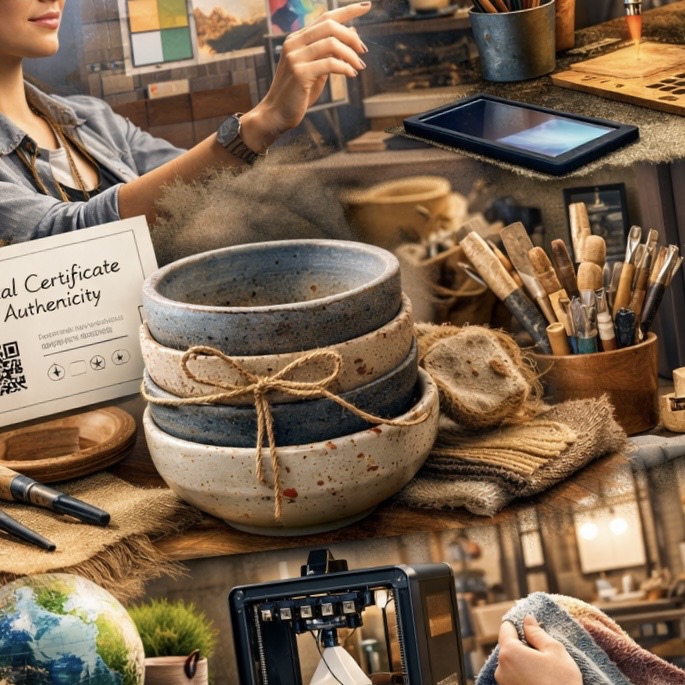
In 2026, art and craft sit at a fascinating crossroads. They are no longer defined by a single medium, method, or philosophy, but by an ongoing conversation between tradition and technology, speed and slowness, individuality and global connection. What makes this moment unique is not simply new tools, but a renewed clarity about why people make things at all.
A Return to the Handmade—With New Intent
After years of digital saturation, craft in 2026 is deeply intentional. Pottery, textile work, woodworking, printmaking, bookbinding, and other tactile practices are experiencing a quiet renaissance. People are not rejecting technology; they are reclaiming the sensory experience of making.
What has changed is context. A hand-thrown ceramic bowl today may be sold through a global marketplace, documented on short-form video, and paired with digital certificates of authenticity. The object remains handmade, but its life extends far beyond the studio.
Craft is no longer seen as nostalgic or secondary to “fine art.” Instead, it is valued for its honesty, durability, and connection to time—qualities increasingly rare in an instant economy.
AI as Collaborator, Not Replacement
In 2026, artificial intelligence is firmly embedded in the creative process, but its role is clearer and more disciplined than in earlier experimental years. Artists use AI to:
- Explore compositions and color palettes
- Generate reference material or variations
- Prototype ideas rapidly before committing to physical materials
- Translate concepts across mediums (text → image → object)
Crucially, authorship has become a cultural focus. Artists openly document how AI is used, positioning it as a tool—much like a camera, loom, or printing press—rather than a substitute for creative intent.
The most respected work blends human judgment with computational possibility. Imperfection, choice, and restraint are now markers of authenticity.
Craft as Resistance to Disposability
Sustainability is no longer a trend; it is a baseline expectation. In 2026, art and craft increasingly reject mass production, synthetic excess, and planned obsolescence.
Materials matter:
- Natural fibers over plastics
- Local clays, woods, and pigments
- Reclaimed, recycled, and repurposed components
Artists are transparent about sourcing and process, and audiences are educated enough to care. Craft objects are designed to age, to be repaired, and to accumulate meaning over time.
This shift has made craft quietly political—not loud or didactic, but firm in its values.
Hybrid Spaces and New Economies
The studio of 2026 is rarely just a studio. It is often:
- A workshop and livestream set
- A classroom and content channel
- A local space with global reach
Artists fund their work through a mix of commissions, subscriptions, limited releases, workshops, and digital products. Craft education has expanded beyond institutions into peer-led communities and micro-schools.
The barrier to entry is lower, but the expectation of quality is higher. Audiences are discerning, and trust is earned through consistency and clarity of voice.
Art as Meaning-Making in Uncertain Times
Perhaps most importantly, art and craft in 2026 respond to a world shaped by rapid change—economic shifts, climate pressure, and accelerating automation. In this environment, creative work serves a vital role: helping people slow down, reflect, and reconnect with what is tangible and human.
Art is not only about aesthetics. It is about presence.
Craft is not only about skill. It is about care.
Together, they remind us that progress does not require abandoning the human hand—only reimagining how it works alongside intelligent tools.
Leave a Reply